
What Do Standards Development Organizations Gain by Adding FHIR Terminology Services?
By Jesse Efron, Chief Operating Officer at West Coast Informatics. Published on the TermHub blog July 27, 2026.
Quick answer: Standards development organizations (SDOs) and other healthcare terminology organizations publish clinical terminologies typically through file distribution mechanisms to serve their users. Adding a managed FHIR API terminology distribution service to the existing infrastructure gives a terminology organization six important benefits:
Enable teams to focus on knowledge, not technology
Increase user engagement and power new applications
Support live querying and validation on demand
Gather metrics on how content is used in the real world
Reuse security and licensing approaches already in place
Improve content quality and version management
FHIR Terminology Services, defined by HL7, specify a standard REST API for publishing and accessing terminology content on demand across healthcare systems. Rather than downloading and processing entire terminology releases, applications can retrieve exactly the content they need through standardized API operations.
A managed FHIR terminology service delivers these capabilities through a production ready platform with packaged hosting, production grade operations, versioning, security, monitoring, and quality assurance, eliminating the need for organizations to build and maintain additional infrastructure. This allows organizations to build on their existing distribution mechanisms, enhance user engagement and experience, and offer entirely new ways of interacting with their terminology content.
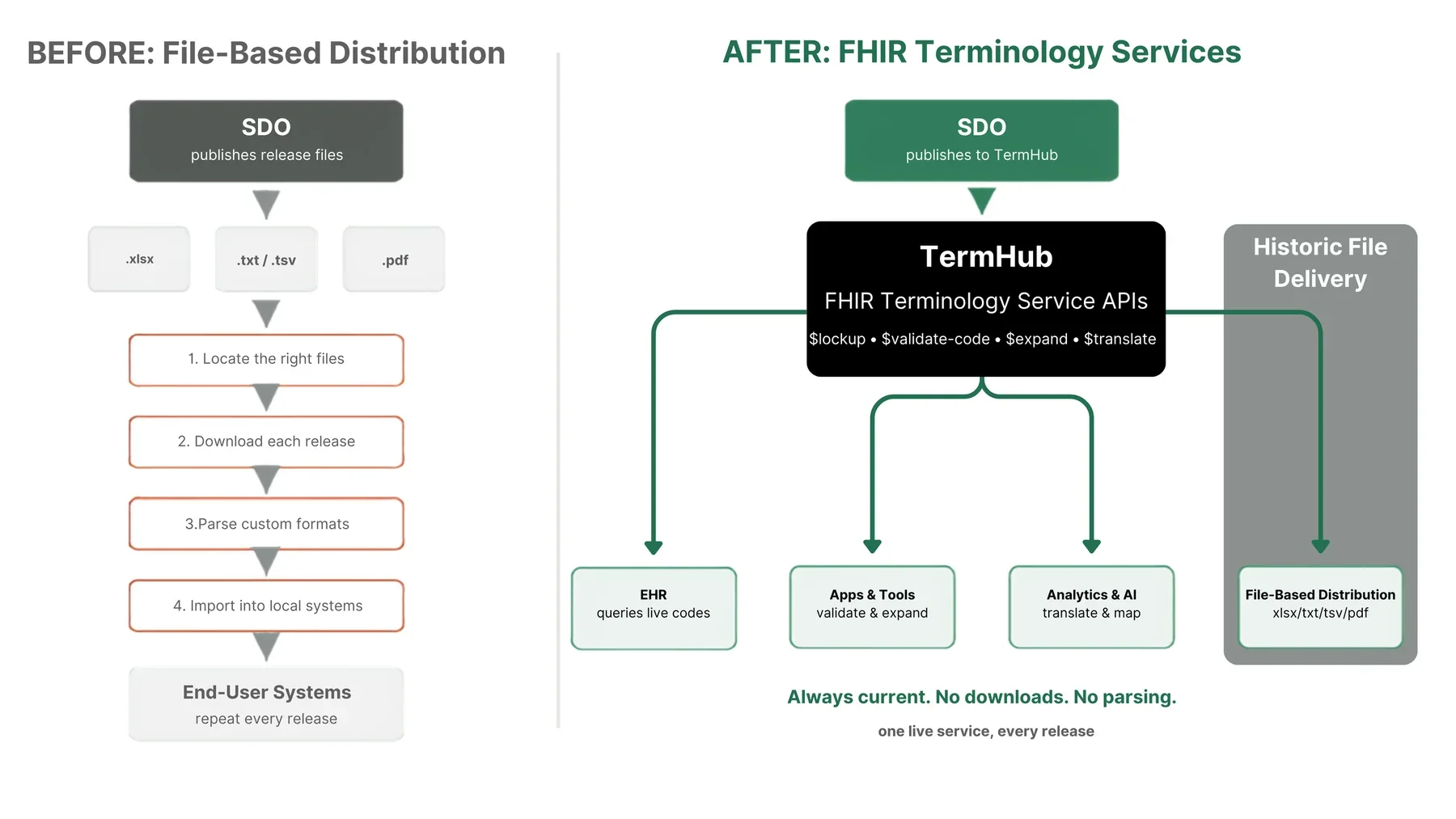
How does a managed FHIR terminology service let teams focus on knowledge?
By moving distribution technology to a managed service, teams can spend their time on content rather than the infrastructure. Running a production terminology server takes engineering, hosting, and staffing that sit outside the work of developing and maintaining a terminology. A managed FHIR terminology service handles that layer, which keeps the team focused on the knowledge it exists to advance. Existing channels stay in place, and the API capability is added without new servers or headcount.
The team also keeps a voice in how its content is represented in FHIR. Those decisions do not get handed off to a vendor. The people who develop a terminology understand it more deeply than anyone else, and letting that understanding shape the FHIR view means the data reflects how the content is actually meant to be used. Because the content comes from the source, the way it is modeled becomes the reference the rest of the industry builds on. Everyone working with that terminology sees the same structure, which means data looks consistent wherever it is used.
How does a FHIR terminology service reach more users and power new applications?
By providing a means for users and developers to instantly access the content without downstream parsing or processing operations. This approach encourages developers to build applications directly on top of the service (like developers have done with RxNav, NLM's public RXNORM API). Because a managed service delivers the content through standard, production-grade FHIR interfaces, more systems and more teams can consume it without a custom integration for each one. Application builders can treat the terminology as a live building block rather than a file to import. Existing implementers benefit too, since the same standard interface makes their integration faster and more consistent. The result is a wider audience for the standard and more ways for that audience to put it to work.
What can implementers do with a live FHIR terminology service?
Query exactly what they need, when they need it. Instead of needing to load a full release to answer a single question, an implementer can request the precise code, value set, or mapping in front of them, through standard FHIR terminology operations.
| Operation | What it does | Example question it answers |
|---|---|---|
Find |
Supports search across FHIR resource types to discover available content | "What terminologies are available here?" |
Get |
Returns metadata for a particular resource | "What are the details of a particular terminology?" |
$lookup |
Returns a code's details | "What are the properties for LOINC 4548-4?" |
$validate-code |
Confirms a code is valid | "Is this code valid in this version?" |
$expand |
Lists the members of a value set, or searches among them | "Give me every code in the diabetes value set" or "Find all codes matching 'diabetes'" |
$translate |
Maps a code to another system | "What are the ICD-10-CM codes for this SNOMED CT code?" |
The current content version as well as prior historical versions can be hosted and accessed the same way, so the right content is always a request away. Users can seamlessly migrate to new versions exactly when they need to with a simple parameter change.
What usage metrics do terminology organizations gain from a FHIR service?
Clear metrics on how their content is actually used. When distribution runs through a live service, each request becomes a usage signal, so an organization can see which codes implementers rely on most, how usage varies by region, and which versions are in active use. Those metrics support real decisions:
Commercial: tier, scale, or price offerings around actual usage.
Roadmap: prioritize future updates based on what implementers use.
Operational: understand which content is live in production.
A managed FHIR terminology service can be configured to surface this level of insight directly, with no separate analytics work to build.
How does a FHIR terminology service protect content with the security you already trust?
By securing the API with the same mechanisms an organization already uses for its bulk data. The credentialing, access control, and licensing applied to file distribution carry over to the API, so there is nothing new to invent and nothing to govern separately. The same holds for quality: the identical QA and semantic validation rules apply to the API representation, so what is delivered through the service meets the same standard as everything else the organization publishes. Licensed content stays licensed, protected content stays protected, and the quality bar stays exactly where the organization sets it.
How does a FHIR terminology service support version management?
By making version management straightforward for both the organization and its implementers. Implementers can see which version is current and reach it directly, and they can view the full version history and pull a specific prior release whenever they need it. The organization publishes on its own release cycle, and the managed service keeps every version hosted and available without extra operational work. In healthcare, keeping implementers aligned on the version they intend to use directly supports data integrity and safety. Every version carries the same quality assurance and semantic validation as the current release, so accuracy does not depend on which version an implementer is using.
Where is clinical terminology distribution heading?
Toward live, API-driven access alongside the files organizations already publish. FHIR terminology services are now the leading global standard for how clinical terminology is distributed and consumed, and healthcare implementers increasingly expect a live API in addition to downloads. The strongest position is to offer both: keep the file distribution existing users depend on, and add a managed FHIR terminology service for everyone who wants live access, richer usage metrics, and current content, all while retaining full ownership and governance of the content.
Frequently asked questions
What is a standards development organization (SDO)?
An organization that develops and maintains clinical terminologies and code systems used across healthcare. Widely used examples of such terminologies include LOINC, SNOMEDCT, ICD10CM, and RXNORM. Some groups that develop terminologies do not think of themselves as standards bodies, so this can also be read to include terminology development organizations more broadly.
What is FHIR terminology distribution?
Delivering clinical code systems and value sets through live FHIR Terminology Service APIs, using resources such as CodeSystem, ValueSet, and ConceptMap, so implementers query the specific content they need through operations like $lookup, $validate-code, $expand, and $translate.
Does adding a managed FHIR terminology service replace file distribution?
No. It is an addition. Existing file distribution stays in place for the users who rely on it, and the FHIR API is layered on top for those who want live access.
Is a managed FHIR terminology service different from just using FHIR?
Yes. FHIR is an open standard that anyone can implement, supporting a broad set of clinical resources. A managed FHIR terminology distribution service offers terminology services for the organization: hosting, production-grade operations, versioning, security, and quality checks. In this way, organizations realize the benefit without building or maintaining the infrastructure.
What do terminology organizations gain by adding a managed FHIR terminology service?
The team can focus on content rather than infrastructure, the content reaches more users and supports new applications, implementers can query and validate on demand, the organization gains usage metrics, the API is secured with the same mechanisms already used for bulk data, and version management is straightforward, all while the organization keeps full ownership of its content.
Who builds managed FHIR terminology services?
We do. TermHub is built by our team at West Coast Informatics, which has spent decades stewarding and implementing widely used clinical terminologies including SNOMEDCT, RXNORM, LOINC, and ICD10CM.
If your organization is exploring how to add FHIR access to its existing distribution, learn how TermHub supports standards development organizations. We announced this managed FHIR offering for SDOs in May 2026, and organizations have been adding it alongside their existing distribution since.